Navigate this section:
- A decade of mobilising climate finance
- Funding the future: CREWS’ multiple financing pathways
- Beyond funding: a platform for scaling up
- Enabling large-scale investment: CREWS’ de-risking mechanisms
- Scaling up finance for early warning: replicating the model
- Improving early warning in LDCs and SIDS: looking beyond 2027
- Expanding CREWS’ expertise: formalising partnerships
- Joint Leadership Messages
A decade of mobilising climate finance: How CREWS is transforming the climate finance landscape
The global demand for climate resilience and early warning investments has never been more urgent. One-third of the global population still lack early warning coverage, and nearly half of LDCs lack adequate early warning systems.1 Yet the path from ambition to implementation remains fraught with obstacles. Funding for early warning systems is fragmented and geographically skewed towards a few countries. In the 2025 Global Status Report on multi-hazard early warning systems, it was reported that 4.04 billion US dollars (US$) had been approved for funding these systems. However, official development assistance is declining and funding from multilateral development banks and institutional funds – largely provided through loans and credit that must be re-paid rather than grants – continues to be out of reach for many LDCs and SIDS. This is largely due to a perception that the investments are high-risk and that countries have limited domestic capacity to design and execute complex projects. In this challenging environment, CREWS stands out as more than another funding mechanism but as a transformative platform guiding countries from stand-alone pilots to sustainable national early warning systems.
- United Nations Office for Disaster Risk Reduction and World Meteorological Organization (2025). Global status of multi-hazard early warning systems. Geneva, Switzerland. Accessed April 2026: https://library.wmo.int/idurl/4/69684
Funding the future: CREWS’ multiple financing pathways
Every CREWS investment is linked to larger financing opportunities, providing a clear route towards national ownership and sustained financing for early warning systems and services. This approach aligns with the strategic priorities set out in the CREWS Strategy through its catalytic funding, policy influence and commitment to sharing knowledge and supporting innovative approaches.
Through its three funding pathways, CREWS interventions support countries by providing technical support for preparatory work and by strengthening institutional and technical capacity whilst establishing essential services which demonstrate both readiness and potential for scaling up (see Figure 1).
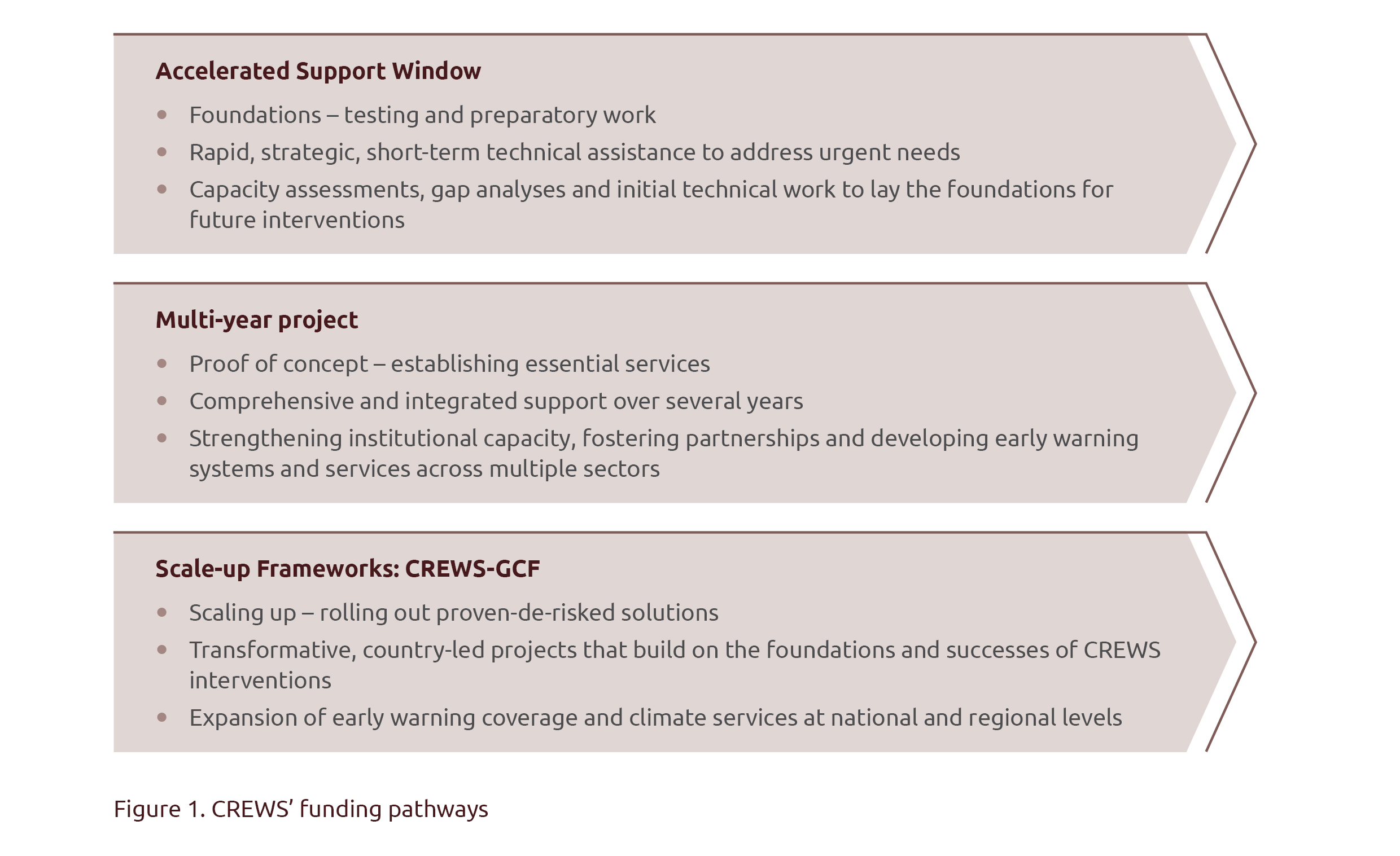
Five multi-year projects are featured in this year’s Annual Report, including two countries which have benefited from more than one CREWS investment: Malawi (see Malawi project feature) and Togo (see Togo project feature) and other projects which are in or entering a second phase.
In Malawi, targeted support for the pilot testing of the use of artificial intelligence in weather forecasting was provided through an Accelerated Support Window action. This is an example of how CREWS can provide short-term funding for trialling of innovative approaches. Countries can also apply for funds to undertake preparation work – such as diagnostics – building a foundation for future investments. In special cases – such as that of Guinea (Box 2) – short-term funding from CREWS can provide an essential bridge to sustain life-saving services whilst other projects come online.
At the other end of the spectrum, Togo was the first country to be approved for funding from the Green Climate Fund (GCF) through the GCF-CREWS scaling-up framework, building on the success of the CREWS multi-year project “Togo – Hydromet and Early Warning Services”.
Box 2. Accelerated Support Window: Strengthening meteorological services in Guinea to harness future investment
US$ 250 thousand – Led by WMO – Continued Assistance and Advisory Services


The US$ 250 thousand ASW in Guinea ensured the continuation of essential meteorological services in challenging circumstances whilst also helping Guinea’s National Meteorological Service (ANM) to improve its readiness for future investment:
“The Guinean meteorological service had long been housed in a very dilapidated building, which was further damaged on the night of 17-18 December 2023, during the fire at the Conakry fuel depot. The meteorological service was left without a workspace. To ensure continued service, it relocated to a temporary, rented building. Support from CREWS enabled the service to pay the rent for 2024, thus ensuring continuity of service and providing staff with a comfortable workspace, thereby increasing their efficiency. As construction of the new building is not yet complete, the Agence Nationale de la Météorologie (ANM) continues to occupy this temporary building. We are extremely grateful to the CREWS initiative for this support, without which the ANM would be in a much more difficult situation.” Dr René Tato Loua, Director General, ANM
In the first of two components, CREWS funds supported the continuation of ANM operations by renting suitable office accommodation and providing a robust internet connection. Meanwhile, the technical assistance provided by CREWS enabled ANM to make improvements to its systems and services, including connecting 28 stations to the WMO Information Service, a data-sharing platform. With CREWS support, ANM also launched a new public website which supported the issuance of warnings that are compliant with the Common Alerting Protocol (CAP) standard. Guinea’s warnings were subsequently integrated into Google Public Alert, ensuring their availability across all Google platforms, a first for Africa and testament to their reliability.
CREWS funds were also used to strengthen ANM’s institutional foundations and legal framework, which was a pre-requisite for effectiveness of the CLIMAGUI project. This 6 000 000 euros (€) project implemented by the Government of Guinea and funded by Agence Française de Développement (AFD) aims to reinforce ANM. CREWS support on institutional and legal frameworks has been designed to improve accountability and transparency of the agency, thereby supporting ANM’s capacity to implement activities funded by AFD and by the government. Aligned with national policies and development frameworks CREWS also supported the development with national consultants – and validation by the ANM Board – of ANM’s national strategic plan, action plan and business plan. Regulations on revenue generation were also drafted, providing a mechanism for funding services in the future.
With exceptional commitment from ANM staff, a strong sense of national ownership and support from development partners as well as institutions (nationally and regionally), the ASW in Guinea has ensured continuity of services, avoided duplication of efforts and promoted efficient use of limited resources. Whilst challenges remain, including delays to the completion of building works, CREWS’ flexible funding approach has ensured operational continuity and enabled the inception of a large capacity development project.
Beyond funding: a platform for scaling up
CREWS leverages its convening power to align governments, donors, and technical partners. By strengthening the foundational elements of early warning and climate services, CREWS transforms its projects into bankable, scalable investments. The success of this approach is most clearly demonstrated through the scaling-up framework between CREWS and the Green Climate Fund.1 This framework serves as a model that other funds and development banks might replicate. Crucially, it shows how targeted, early-stage support can reassure major international funders that the desired outcomes – and impacts – of their investments will be realized and sustained.
The logic is simple but disciplined. It begins with upstream support that strengthens the technical and institutional foundations of early warning systems. This includes improving data quality and sharing, strengthening coordination and collaboration among institutions, and addressing gaps in service delivery. These steps reduce uncertainty, both for countries and for financiers. Once early results are demonstrated and national ownership is clear, larger financing can be mobilized more quickly and with greater assurance.
The partnership between CREWS and the Green Climate Fund has already begun to deliver results. The first projects to be developed under the framework show how relatively modest initial investments can unlock significantly larger flows of finance. To date approximately US$ 50 million has been approved to support climate-resilient development and early action programmes firstly in Togo and then in Belize and Trinidad and Tobago (see Box 3). There are at least 12 more projects in the pipeline, including ones for Cambodia, Gambia, Fiji and Mauritania. However, with only around half of all LDCs and SIDS reporting the existence of multi-hazard early warnings,2 the demand for CREWS support – and funds for scaling up – remains very high.
Box 3. GCF-CREWS scaling up in Belize and in Trinidad and Tobago
US$ 27.1 million – Executing Entities: Caribbean Meteorological Organization and the Caribbean Development Bank

Scaling up and expanding on the outcomes of the first phase of the regional CREWS Caribbean project, this US$ 27.1 million GCF project3 – including a US$ 24.1 million grant from the GCF – will strengthen hydrometeorological and early warning services in Belize and in Trinidad and Tobago as well as in 14 other members of the Caribbean Meteorological Organization.
The project is designed around three complementary outcomes. These will build the technical and institutional foundations for effective early warning by improving governance, infrastructure and forecasting capabilities while enhancing resilience across key sectors. The project also seeks to improve risk communication and preparedness at the community level, ensuring that timely, actionable climate and weather information reaches vulnerable populations.
This investment demonstrates how CREWS projects provide a platform for scaling up – and fast-tracking financing modalities – to implement effective early warning systems at national and regional levels.
- CREWS (2023). GCF-SAP CREWS scaling[-]up framework for early warning. Accessed April 2026: https://crews-initiative.org/wp-content/uploads/2024/07/20231121_CREWS_GCF-SAP_web-pages.pdf
- United Nations Office for Disaster Risk Reduction and World Meteorological Organization (2025). Global status of multi-hazard early warning systems. Geneva, Switzerland. Accessed April 2026: https://library.wmo.int/idurl/4/69684
- Green Climate Fund. SAP063: Scaling up of Caribbean Hydrometeorological and Multi-hazard Early Warning Services (CREWS) in Belize and Trinidad and Tobago, accessed April 2026: https://www.greenclimate.fund/project/sap063
Enabling large-scale investment: CREWS’ de-risking mechanisms
CREWS employs a multi-dimensional de-risking strategy that prepares the ground for large-scale climate investment (Figure 2).
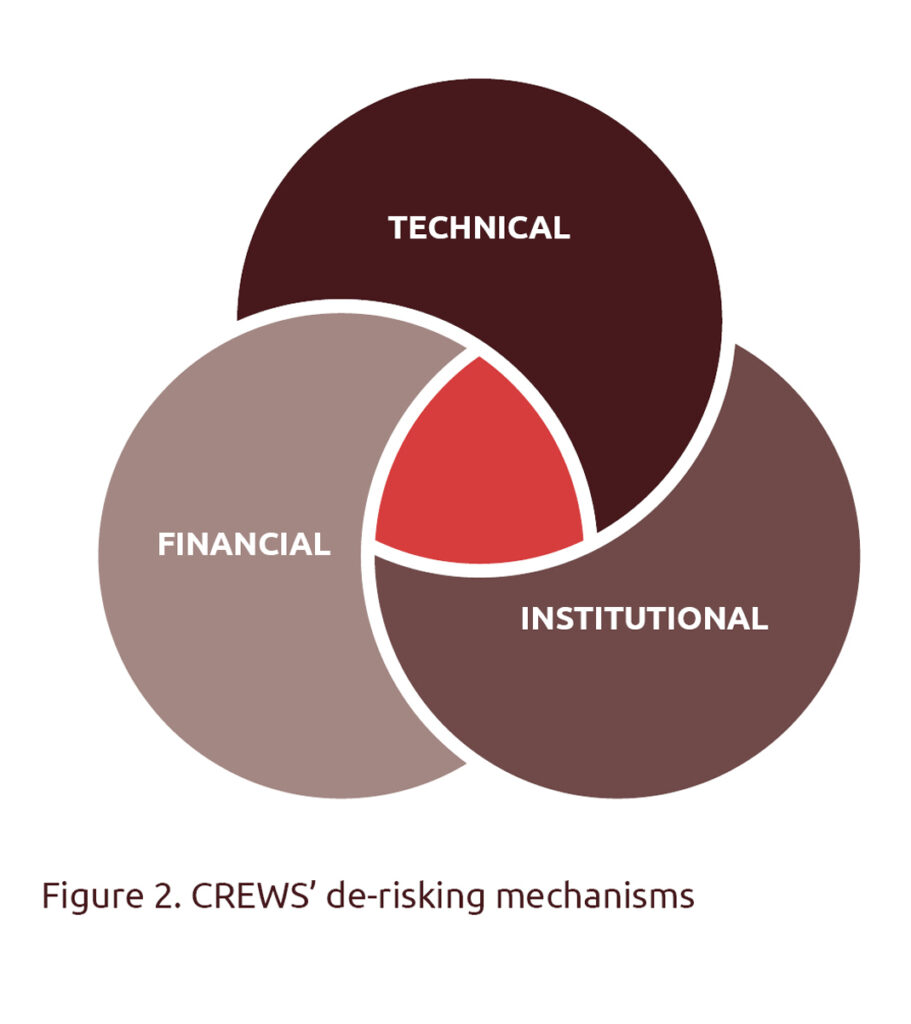
Technical: CREWS focuses heavily on improving the quality of hydrometeorological data, weather forecasts and warnings, and climate services. By ensuring that technical foundations are robust, CREWS guarantees that proposed interventions are both viable and effective in delivering life-saving impacts.
Institutional: CREWS strengthens governance and coordination by convening and aligning national ministries, agencies and development partners around a shared vision. Institutional strengthening reduces implementation risks and ensures that systems remain operational long after the initial funding period has ended. Alignment at national and regional levels reduces duplication of effort and amplifies the overall impact of every dollar invested.
Financial: CREWS-supported projects provide major financing institutions – such as the World Bank and the Green Climate Fund – with the proof of concept and evidence of readiness that they require before making significant investments.
Scaling up finance for early warning: replicating the model
Still, the work is far from complete and the need to replicate the model is urgent.
The GCF-CREWS scale-up framework provides a tested pathway for meeting the global need for early warning systems. A similar approach could be adopted across other climate and development finance mechanisms, with modifications made to the model to suit each institution’s mandate, risk appetite and operational constraints. What matters most is the core principle of facilitating a structured handover from upstream de-risking to scaled investment. However, it is important for each funder to share their pipelines to ensure a coherent approach which avoids duplication and maximizes complementarity across the investments.
In practice, this would begin with each financing mechanism establishing dedicated windows for early-stage proof of concept and institutional strengthening work. Sustained financing for maintenance and operations – including data quality control and sharing – must also be prioritized. Treating these elements as core investments, rather than secondary considerations, will improve both performance and sustainability. Finally, partnerships must extend beyond government institutions and reach the last mile. Early warning systems succeed only when they reach people and enable action.
Looking ahead, the opportunity is clear. The GCF-CREWS scaling-up framework demonstrates that when risk is reduced, national ownership is strengthened and pathways are clearly defined, investment can follow more quickly and with greater impact. Extending this approach across other financial mechanisms would allow countries to spend less time navigating fragmented processes and more time delivering services that protect people. It would shift the focus from isolated successes to systemic change.
CREWS is doing more than just funding individual projects; it is building the fundamental conditions required for climate resilience to reach a global scale. By methodically reducing risk, strengthening national systems and mobilizing a broad coalition of partners, CREWS ensures that climate investments are larger, smarter, more sustainable and more readily available.
Improving early warning in LDCs and SIDS: looking beyond 2027
By helping the world’s poorest and most at-risk countries and territories to build inclusive, people-centred early warning systems against hazards, CREWS is strengthening their resilience to climate shocks. As the only dedicated fund supporting early warning systems, from the launch of Early Warnings for All (EW4All) in 2022, CREWS was recognized as an essential delivery vehicle for achieving this important global goal by 2027.1 Beyond this timeline, CREWS has made a strategic commitment to continue this work until at least 2030, with current programming out to 2029.
Building on a decade of delivery and launched at the Conference of the Parties in Belém in November 2025 (COP30). CREWS’ Strategy 2030 “positions CREWS as a transformational enabler: beginning with targeted support, building and strengthening foundational capacities, and unlocking scaled, sustainable investments that reduce loss and damage and build long-term resilience.”2 The Strategy is formulated around three strategic priorities:
- Strengthening foundational early warning and climate services
- Catalysing transformation through scaled finance
- Driving next-generation systems
Whether working at the national or the regional level, CREWS supports the development – and implementation – of budgeted strategic/investment plans that prioritize multi-hazard early warning. These country-led plans are foundational, promoting coherence and providing an entry point for targeted investments by funders and development partners. By supporting countries/ territories to develop these plans, CREWS is encouraging them to act. The existence – or absence – of these important documents is represented by CREWS’ first core indicator: Outcome 1: National and local multi-hazard early warning systems prioritized and funded (see Appendix 1). Thanks to CREWS support 14 countries now have EW4All Roadmaps.3 These strategic documents serve as national blueprints for mobilizing investments in early warning systems and services. Recognising the importance of these plans to catalyse investment in their countries, another 5 countries have embarked on the development of national EW4All Roadmaps: Chad, Togo, Kiribati, Mauritius and Nepal.
- Launched by the Secretary General of the United Nations in 2022, the aim of EW4All is to protect everyone on Earth from hazardous weather, water or climate events by the end of 2027. United Nations. Early warnings for all. Accessed April 2026: https://www.un.org/en/climatechange/early-warnings-for-all
- CREWS. From delivery to transformation: Scaling CREWS’ impact to 2030. Our Strategy. Page 2. Accessed April 2026: https://crews-initiative.org/wp-content/uploads/2025/11/CREWS-2030-Strategy_ENG.pdf
- Afghanistan, Cambodia, Comoros, Fiji, Haiti, Lao People’s Democratic Republic, Madagascar, Niger, Seychelles, Samoa, Solomon Islands, Somalia, Sudan and Tonga have developed EW4All Roadmaps thanks to CREWS support.
Expanding CREWS’ expertise: formalising partnerships
By encouraging a systems approach to the design, development and implementation of early warning systems, CREWS projects often include activities and outputs from each element of these systems and thus, every pillar of EW4All.1 With two of the EW4All pillar leads already implementing CREWS projects, in 2025, CREWS initiated the accreditation of the remaining pillar leads – the International Telecommunications Union (ITU), lead for Pillar 3 and the International Federation of Red Cross and Red Crescent Societies (IFRC), lead for Pillar 4. The accreditation process for both organizations is expected to conclude in June 2026 and once completed, ITU and IFRC will join the other pillar leads (UNDRR and WMO) – as well as the World Bank’s Global Facility for Disaster Reduction and Recovery (GFDRR) – as Implementing Partners of CREWS projects. However, both ITU and IFRC have already participated in CREWS projects, not least through the EW4All Accelerator project, where they have provided technical support to the seven focus countries, including Madagascar (see Box 4).
- Pillar 1. Disaster Risk Knowledge (led by UNDRR); Pillar 2. Detection, observation, monitoring, analysis, and forecasting (led by WMO); Pillar 3. Warning dissemination and communication (led by ITU); and Pillar 4. Preparedness and response capabilities (led by IFRC).
Joint leadership messages
“One of the top priorities of the global Early Warnings for All initiative is to reach the last mile in Least Developed Countries and Small Island Developing States, who are the most vulnerable to the impacts of severe weather and a changing climate. Since the launch of CREWS in 2015, WMO has worked hand in hand with national meteorological and hydrological services and regional centres to deliver life-saving early warning systems which lead to action. As CREWS marks its first decade and looks ahead to scaling up under Strategy 2030, the urgency has never been greater. WMO stands ready – through its people, programmes and partnerships – to meet this growing demand and protect communities worldwide.”
Celeste Saulo, Secretary-General, World Meteorological Organization
“The World Bank Group values its partnership with CREWS in helping client countries strengthen resilience to weather and climate risks through investments in people, systems and infrastructure. Early warning systems not only save lives – they also protect jobs, keep businesses operating and reduce economic disruption when disasters strike.
The World Bank Group has been at the forefront of expanding access to life-saving early warnings in some of the most at-risk countries – working through CREWS over the past decade and a broad coalition of partners to turn commitment into action. While progress is clear, the scale of need remains significant. We are deepening our engagement, mobilizing financing and helping countries build more resilient, job-supporting growth.”
Ming Zhang, Global Director, Urban, Subnational Finance, Tourism, and Disaster Management, Resilience and Land Global Department, World Bank
“The climate crisis is leading to more devastating disasters. This makes investing in disaster risk reduction ever more urgent, and multi-hazard early warning systems are among the most powerful tools for protecting lives and livelihoods from disasters. That is why UNDRR is proud to be an Implementing Partner of the CREWS Initiative, as a key global mechanism for helping the most at-risk countries strengthen early warning and action systems. As CREWS celebrates its first decade, we congratulate all those who have contributed to its success. We look forward to continued collaboration as CREWS implements its new Strategy 2030 to scale Early Warnings for All.”
Kamal Kishore, Special Representative of the United Nations Secretary-General for Disaster Risk Reduction