Navigate this section:
Foreword
It is with a great sense of honour and responsibility that Canada assumes the role of Chair of the Climate Risk and Early Warning Systems (CREWS) initiative at a pivotal moment for both the initiative and for global resilience efforts more broadly. As climate impacts accelerate amid deepening vulnerabilities and growing geopolitical complexity, the imperative for effective early warning systems has never been clearer – or more urgent.
2025 marks an important milestone for CREWS. Ten years ago, CREWS was founded on a powerful idea: that no community should face the devastating effects of climate-related hazards without being empowered to anticipate, prepare and respond to them. That vision remains as vital now as when it began. Today, the scale and speed of the climate crisis demand that we elevate our ambitions, drive bolder actions, strengthen and expand partnerships and amplify impact. This is why the new CREWS Strategy 2030 is so important.
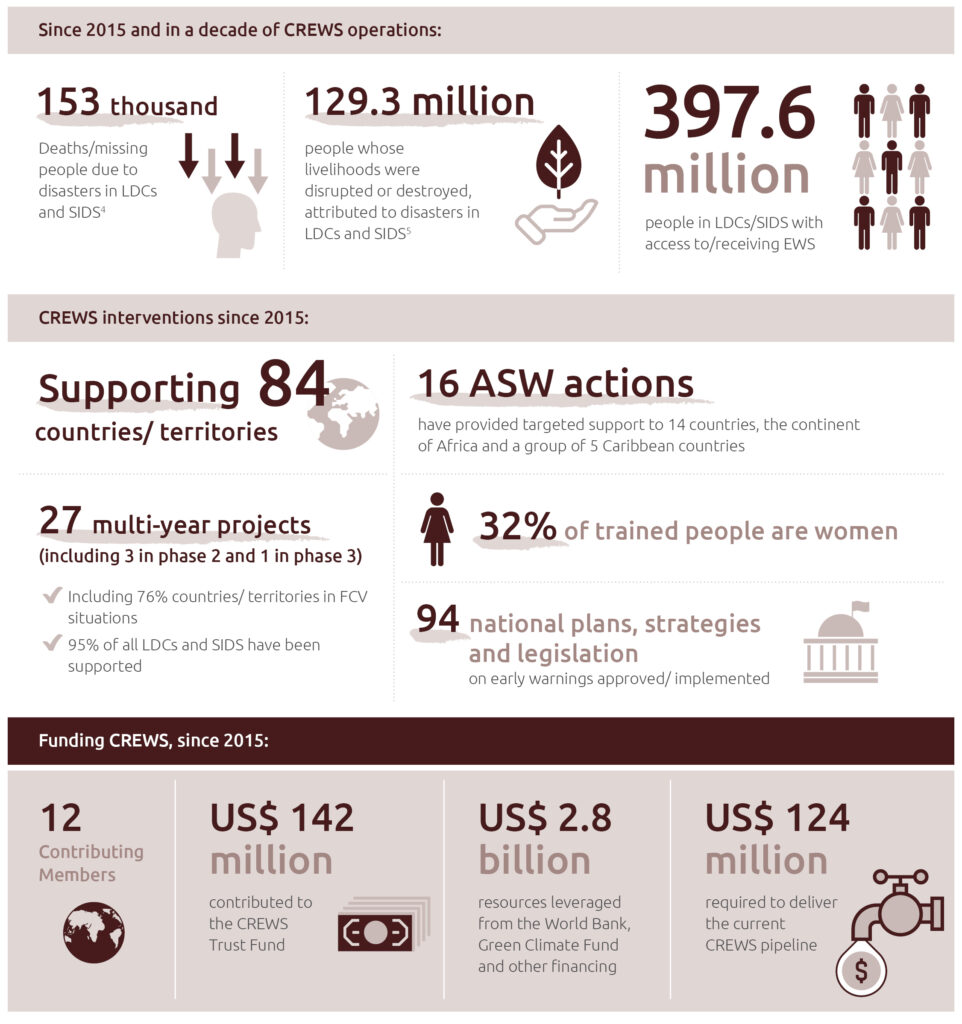
Reflecting on a decade of delivery, we took stock of what we have achieved – and learned – collectively. Since 2015, CREWS has mobilised 142 million US dollars (US$), supported 84 countries and territories, and leveraged an additional US$ 2.8 billion in funding. Building on this strong track record, Strategy 2030 sets the course for the next five years, positioning CREWS to scale up support for countries and regions eager to develop or strengthen people-centred, end-to-end early warning systems to protect communities and empower them to take effective action in response to hazards. It continues to position CREWS as the only initiative which operates across the entire early warning value chain, putting communities and people at the centre of its interventions.
In 2025, CREWS was pleased to invite representatives of least developed countries (LDCs) and small island developing States (SIDS) to join its Steering Committee. This important change speaks to CREWS’ commitment to ensuring that its interventions meet the needs of those on the receiving end. This same commitment underpins CREWS’ development of operational procedures for its operations in countries – and territories – affected by fragility, conflict or violence, ensuring that all interventions in these challenging contexts are undertaken with sensitivity.
The need is great, yet financial resources are finite. It is therefore fitting that this Annual Report highlights how CREWS is mobilising climate finance to deliver country-led programmes focused on early warning. With the commitment of our 12 Contributing Members, we will continue to reinforce and maximize CREWS’ catalytical role, multiplying impact for those who need it most. CREWS’ staged funding approach has proven effective, enabling others to invest with confidence. The Green Climate Fund’s approval of two projects in 2025 that build on – and scale up – the systems and services first developed with CREWS support is the perfect illustration of how CREWS can create the right conditions to mobilize additional resources.
CREWS is also recognised as a key financing mechanism to deliver on Early Warnings for All (EW4All). With CREWS support – through convening stakeholders, assessing technical capabilities, and designing effective systems – countries are developing and implementing their EW4All Roadmaps, improving their governance frameworks and strengthening institutional capacity. The five project case studies featured in this report demonstrate these achievements, looking beyond the numbers to celebrate progress, whilst recognising challenges and drawing lessons from experience.
A wide range of individuals and institutions have been fundamental to CREWS’ success, enabled by its proactive and inclusive approach to building partnerships that bridge sectors and institutions across multiple levels. By harnessing local expertise and complementing it with technical know-how, innovation and services from partners across the public, private, civil and academic sectors, CREWS helps ensure lasting impact.
While we celebrate the achievements of the past decade, we remain humble in the face of the scale of the task ahead. The path forward is not without challenges, but it presents important opportunities. Working together, CREWS and its partners look forward to building on a decade of delivery by scaling impact and strengthening early warning systems in LDCs and SIDS in the months and years to come.
Francis Pigeon
Executive Director, Policy and Partnerships, Meteorological Service of Canada, Environment and Climate Change Canada; Chair, CREWS Steering Committee
A decade of delivery
The Climate Risk and Early Warning Systems (CREWS) initiative was officially launched in December 2015 at the 21st Conference of the Parties (COP21) in Paris, firmly placing early warning systems at the heart of the global agendas on climate – quickly followed by alignment with the Sustainable Development Goals (in 2016) and in 2025, the Global Goal on Adaptation.
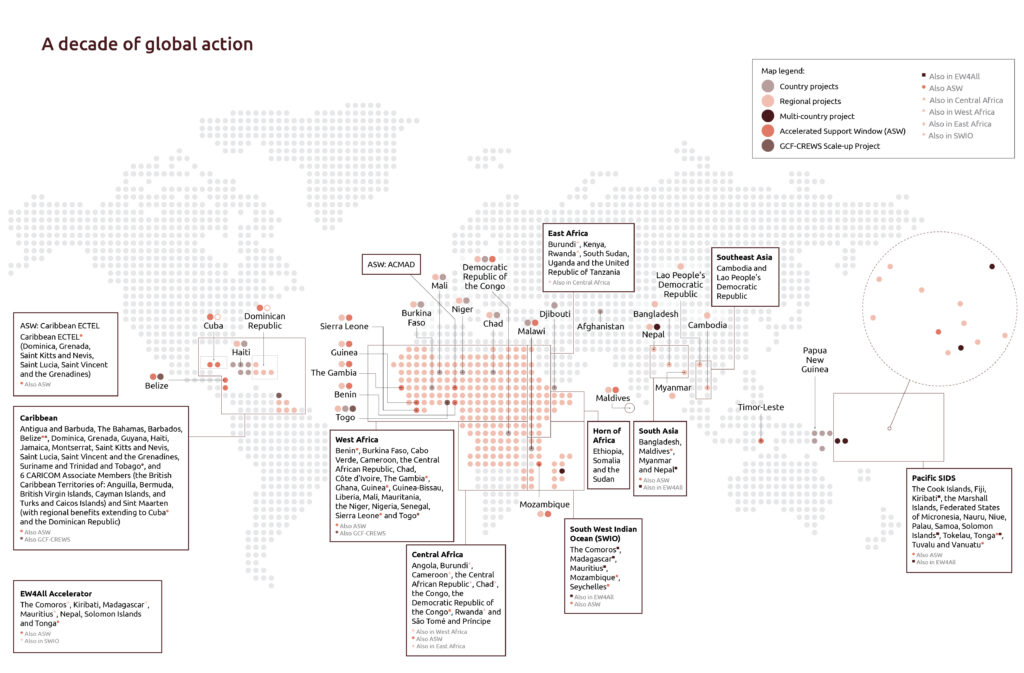
From the outset, CREWS has been a driver for the development and implementation of effective, people-centred early warning systems in the world’s most at-risk countries and territories. Since 2015, CREWS has supported 84 countries/territories through a combination of country, multi-country and regional multi-year projects in addition to a programme of short-term targeted support. Through these interventions, to date, CREWS has supported all but four of the world’s least developed countries (LDCs) and small island developing States (SIDS)1, including three quarters of the countries classified by the World Bank as either experiencing conflict or having high levels of institutional and social fragility.2, Thanks to CREWS support – and through the dedicated work of its implementing, operational and local partners – the coverage and comprehensiveness of early warning systems in many LDCs and SIDS has tangibly improved. This progress is demonstrated by the year-on-year improvements reported in the Global Status Report on multi-hazard early warning systems. It is also evidenced by the data presented in this report and – looking beyond the numbers – through the successes celebrated in the featured projects and in each project’s highlight for 2025 within the regional portfolio overviews.
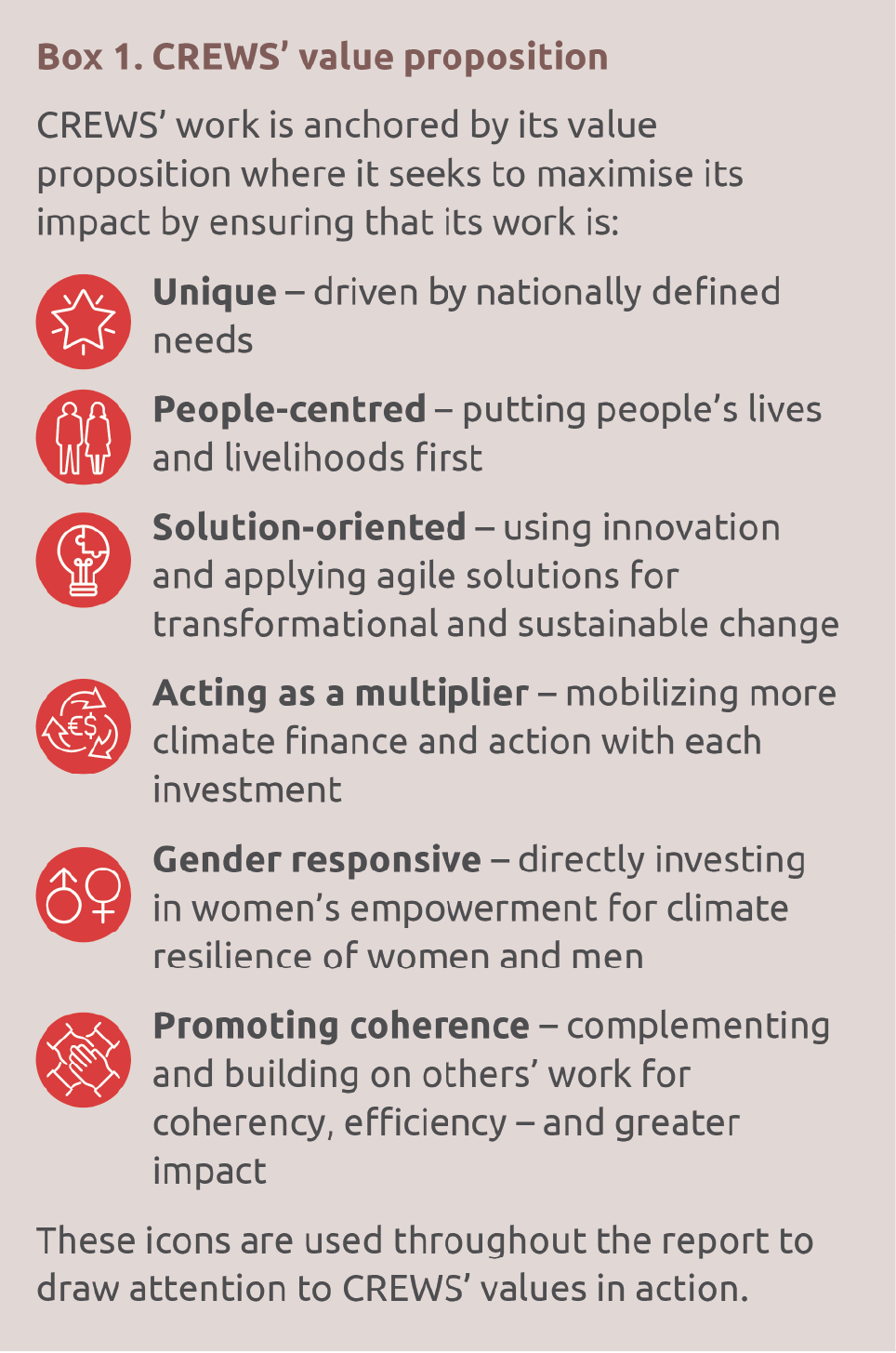
Drawing on a decade of experience, CREWS launched its Strategy 2030 in November 2025. CREWS’ impact to 2030 – defined by three strategic priorities – will be achieved through three interconnected levers: catalytic financing, knowledge and innovation, and policy influence and underpinned by CREWS’ values (see Box 1). In this way, CREWS continues to put people at the heart of everything it does and with a special focus on inclusivity which is demonstrated by the number of projects that are committed to gender equality – an increase from 13 last year to 16 by the end of 2025.
In marking ten years of delivering risk-informed early warning services and improving climate resilience, this year’s Annual Report celebrates not just a year – but a decade – of CREWS’ life-saving work. Simultaneously, it provides a baseline for measuring the impact of CREWS’ new strategy, which commits CREWS to supporting LDCs and SIDS beyond the life of EW4All and through to at least 2030.
CREWS in numbers 2015-2025 [Infographic of key figures, as summarised below]. The only LDCs yet to benefit from CREWS support are Eritrea, Lesotho and Yemen; Singapore is the only SIDS not benefitting from CREWS’ activities.
- Sendai Framework Monitor, April 2026: Data correct to 31 March 2026, noting that not every country/territory reports on every indicator in any given year and that data may be updated retrospectively and at any time.
- Sendai Framework Monitor, April 2026