A decade of effectively managing risks
A risk worth taking
Investing in the most at-risk countries globally – LDCs, SIDS and countries experiencing conflict and/or social and institutional fragility – does not come without risk but is important and comes with high rewards, not least when CREWS projects are scaled up by other funds (see page 12) or leveraged by development partners such as the World Bank in Chad (see Chad Feature). This is evidence of the efficacy of CREWS’ multi-dimensional de-risking strategy – a combination of technical, institutional and financial de-risking – which seeks to prepare the ground for large-scale climate – and hydromet – investment. Understanding the costs, risks and benefits, the CREWS Steering Committee has adopted a high- risk appetite so as to deliver maximum benefit to the communities who most need CREWS support.
Proactively managing risk
Across the CREWS portfolio, risks are actively managed.1 At the project level, risks are managed by Implementing Partners and their collaborators in-country whilst at the portfolio level, the Secretariat manages overall risk with support from a highly effective Steering Committee and from the Trustee.
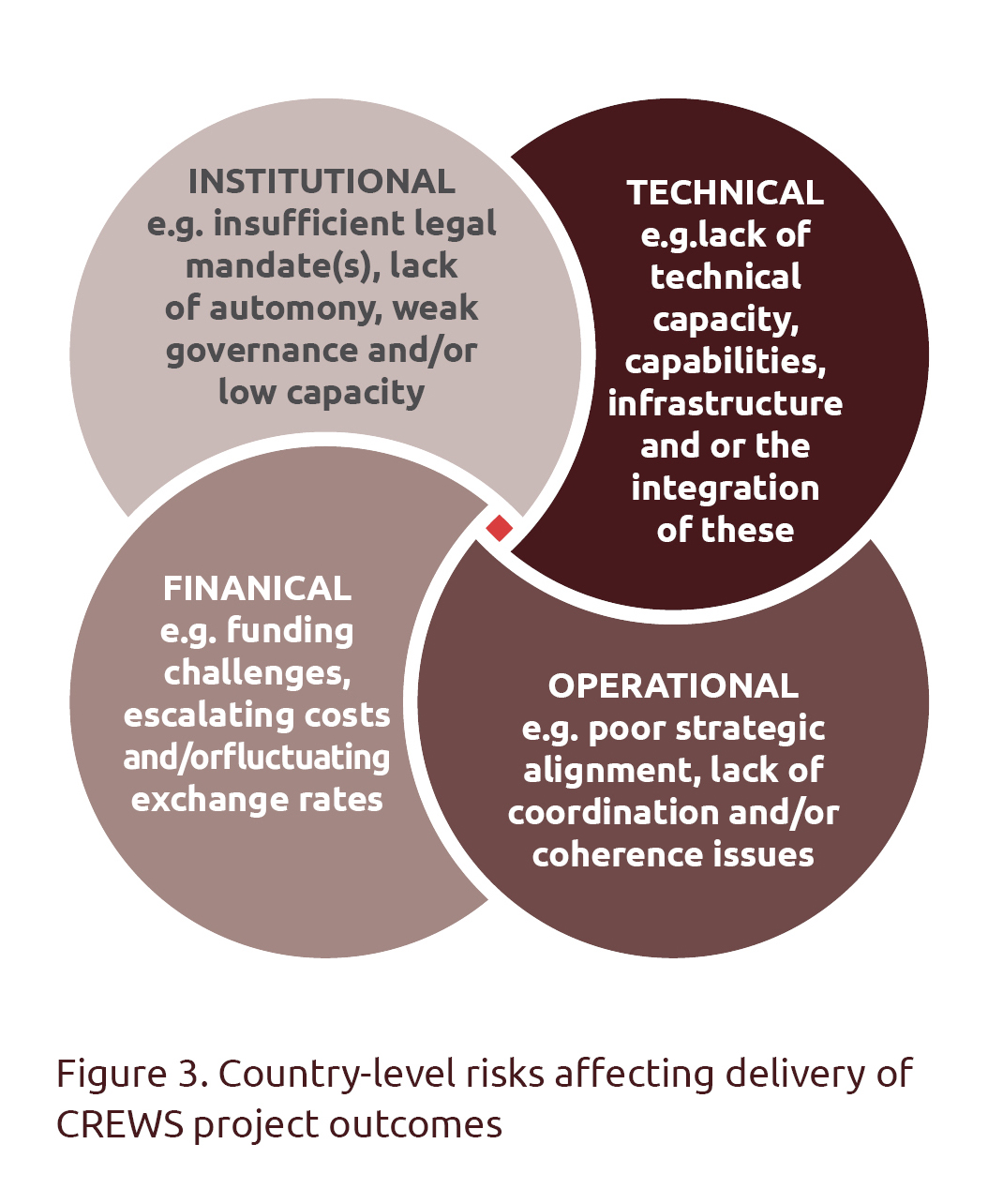
The highest level risks are evident in the countries experiencing conflict or those that are socially or institutionally fragile – external factors which hinder project progress but often are also the root cause of community vulnerability (see Box 5). However, risks exist across the portfolio and unsurprisingly for an initiative which seeks to strengthen resilience by building early warning systems, many projects report technical risks that reflect the need for capacity to be built and infrastructure to be improved and other risks that exist at the country level but also affect project delivery, be they financial, institutional or operational (Figure 3). Project-specific risks typically reflect the lack of availability – and reliability – of resources (human, technical and financial), challenging timelines, escalating costs and the complexities of multi-stakeholder engagement, alignment and coordination.
Box 5. An agile approach that responds to emerging risks and changing priorities From the outset, CREWS has adopted an agile approach to the delivery of its projects. With an efficient Secretariat and streamlined decision-making supported by a responsive Steering Committee, CREWS can respond swiftly to the changing needs and priorities of its projects as Implementing Partners – and their operational counterparts – respond to dynamic situations which can also be both challenging and dangerous. This is most evident in countries that are affected by fragility, conflict and/or violence. Below are just three examples from the last decade of where CREWS has responded to requests for support to sustain essential systems and life-saving services. In Afghanistan, political changes in the country had multiple impacts on project delivery, including challenges in obtaining visas for technical experts, limitations on in-country access and lengthy procurement processes. Recognizing the changing context, the project was restructured in 2023, including an extension to December 2025. Whilst activities resumed at full capacity in 2024, with a constrained operating environment continuing to affect pace of delivery – but not the overall technical progress – the project has been extended again to December 2026. In Guinea, ASW-support provided operational facilities for the Agence Nationale de la Météorologie following a fire that damaged their office (see Box 2). In Haiti, a dynamic risk assessment approach was adopted to ensure that the project could still progress despite a challenging environment.2 However, CREWS also ensured that staff from the Hydrometeorological Unit of Haiti could maintain basic forecasting and warning services during a period of unrest in 2024 by providing Starlink Internet for selected staff to enable them to work remotely when it was unsafe to travel in the country.
A portfolio approach to balancing risk
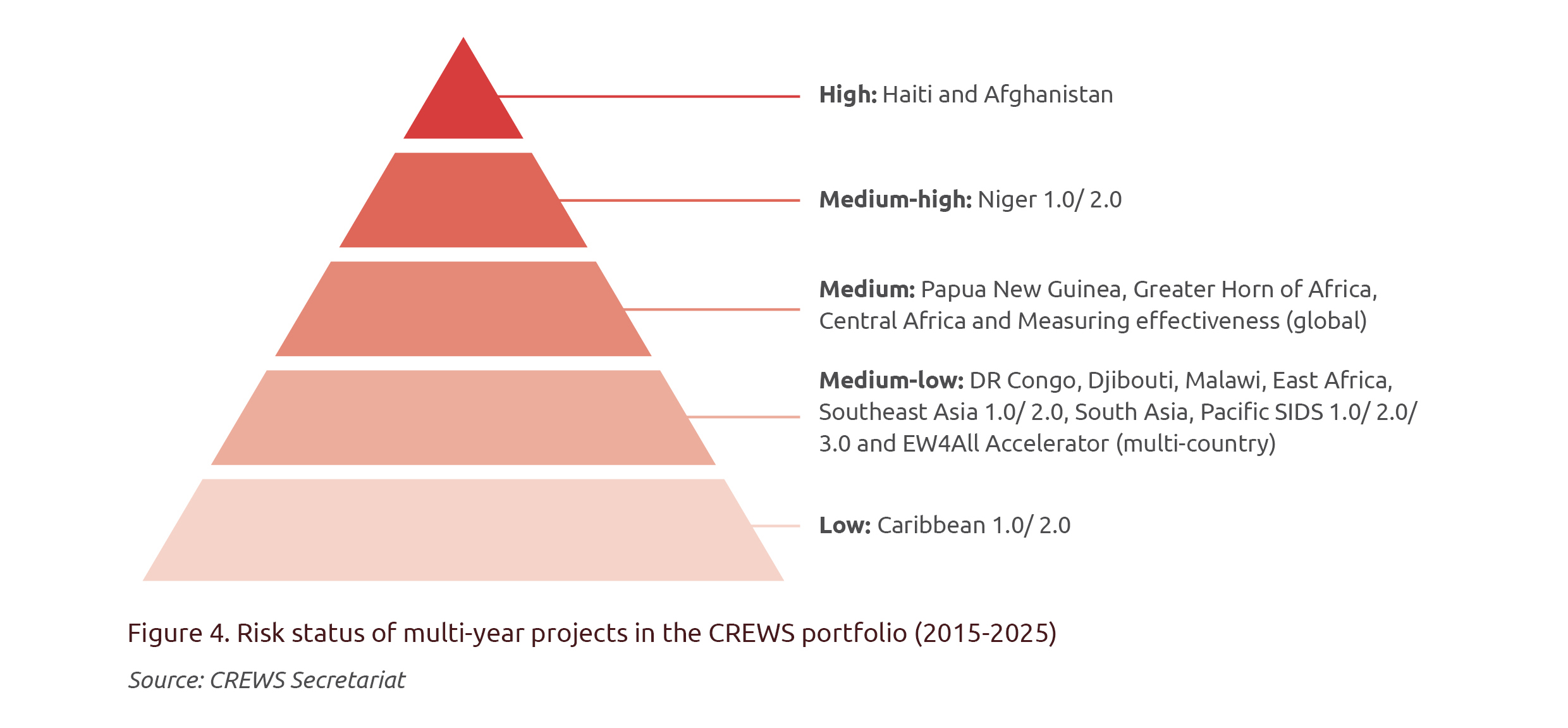
At the portfolio level, there is an opportunity to balance the overall risk through a combination of country-level and regional projects (see Figure 4). Typically, regional projects carry lower risk, in part thanks to the support of highly proficient regional organizations and technical centres. In addition, at the regional level – and also through multi-country projects like the EW4All Accelerator – there are opportunities for peer-to-peer learning and technical support, where more advanced countries and organizations can impart knowledge and experience, share examples of key documents – such as legislation or frameworks for early warning systems – and provide mentoring to technicians in other countries and territories.
The benefit of multilateral cooperation
As a multilateral fund – with thanks to its 12 Contributing Members – CREWS has continued to grow despite a very challenging economic context, including reductions in development funding. CREWS continues to be a reliable partner for the world’s most vulnerable people providing a trusted, country-driven and demand-led mechanism. In the context of a changing climate, never has the need been more urgent.
- CREWS (2017). CREWS Risk Management Approach. Accessed April 2026: https://crews-initiative.org/wp-content/uploads/2024/06/workdoc4_7th_Steering_Committee_CREWS_Approach_to_risk_management-2.pdf
- CREWS (2025). Annual Report 2024: Achieving with confidence – navigating uncertainty. Accessed April 2026: https://crews-initiative.org/reports/